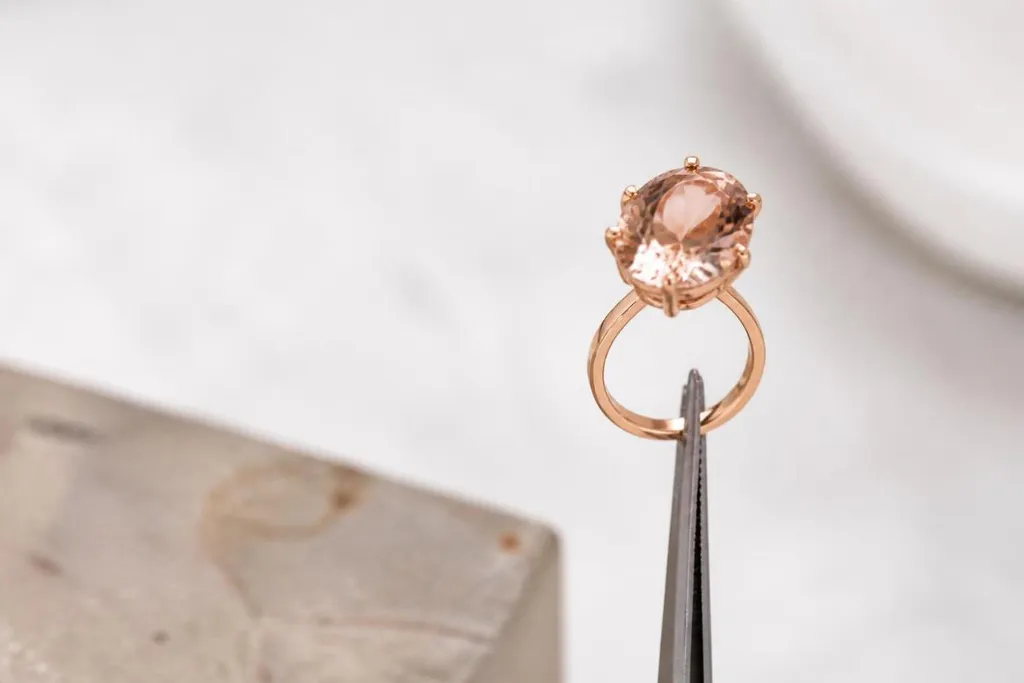
Not every coloured engagement ring needs strong saturation to make an impression. Morganite takes a softer approach, with delicate peach, blush and pinkish tones that give the stone warmth without dominating the entire design. Its understated colour feels romantic, yet sufficiently restrained to work with contemporary settings and everyday jewellery.
For couples considering timeless lab grown morganite engagement rings, the attraction is often this balance between colour and subtlety. Lab-grown morganite can provide the characteristic warm palette associated with the gemstone while allowing cut, metal and setting details to determine how prominently that colour appears. The most successful designs treat the gemstone as part of a complete composition rather than simply choosing the largest or pinkest stone available.
Understanding Morganite's Soft Colour
Morganite belongs to the beryl mineral family, alongside emerald and aquamarine. Rather than intense green or cool blue, however, morganite is recognised for shades ranging from pale pink to peach and salmon.
These nuances matter because the stone can look noticeably different depending on its surroundings. A peachier morganite may appear particularly warm beside rose or yellow gold, while a paler pink stone can create greater contrast against platinum or white gold.
Lighting also influences perception. Daylight may reveal different undertones from warm indoor illumination, so viewing the colour across several environments gives a better sense of how the engagement ring will look in daily life.
For someone who usually wears neutral or understated jewellery, this subtle colour can be an advantage. Morganite provides individuality without requiring the visual intensity of a deeply saturated coloured gemstone.
Cut and Proportion Can Strengthen Its Presence
Because morganite's colour is often delicate, cut and size have an important role in establishing visual presence.
Oval shapes are particularly effective. Their elongated outline provides generous finger coverage and can make a softly coloured stone feel substantial without appearing heavy. Cushion cuts reinforce the gemstone's romantic character with rounded corners and a fuller silhouette.
Emerald-style cuts offer a more architectural alternative, using broad facets and straight lines to showcase areas of colour clearly. Round cuts provide familiar symmetry and can make morganite feel more traditionally bridal.
This is also why someone might prefer a 2-carat morganite over a 1-carat option for reasons beyond simply wanting a larger gemstone. Greater surface area can allow a pale peach tone to become more noticeable on the hand. Another wearer might choose a smaller centre stone surrounded by diamonds, relying on contrast rather than scale to create definition.
Choose Metal and Diamonds With the Colour in Mind
Few gemstones demonstrate the influence of metal choice as clearly as morganite.
Rose gold creates a harmonious, tonal combination. The warm metal can echo the gemstone's blush and peach undertones, producing a soft and cohesive appearance. Yellow gold provides a richer warmth and can work particularly well with peachier stones.
White gold and platinum create more obvious contrast. Their cool colour separates the gemstone visually from the setting, which can make subtle pink tones appear more distinct.
Diamonds provide another useful source of contrast. A halo can frame the morganite with bright colourless stones and increase the ring's overall visual footprint. Diamond-set shoulders offer a more restrained treatment, while a solitaire leaves the gemstone's colour entirely responsible for the character of the ring.
The right combination depends on whether the wearer wants to amplify morganite's warmth or create definition around it.
Consider Morganite's Needs in Everyday Wear
Morganite measures approximately 7.5 to 8 on the Mohs hardness scale. This makes it suitable for jewellery, although it requires more considered everyday handling than harder stones such as sapphire or diamond.
Removing the ring for heavy manual tasks, exercise and activities where it could receive a sharp impact can reduce unnecessary risk. A secure setting is equally important for an engagement ring intended for frequent wear.
Morganite's pale appearance can also make residue from hand creams, soaps and everyday products noticeable. Appropriate gentle cleaning helps preserve its clarity and brightness, while periodic professional inspections ensure the setting remains secure.
Final Thought
Morganite engagement rings offer a distinctive form of modern romance. Their appeal does not depend on intense colour; instead, soft peach and blush tones create warmth that can be enhanced, contrasted or quietly framed through thoughtful design.
Choosing a lab-grown morganite successfully means considering colour, dimensions, metal and everyday practicality together. When those elements are balanced, the result feels neither overly traditional nor deliberately unconventional—simply elegant, personal and comfortably suited to modern engagement jewellery.